
In December, Jewish Federation’s Community Relations Director Rabbi Asher Lopatin led an academic and cultural mission to Syria, with the goal of solidifying and deepening relations with the University of Damascus and the Damascus National Museum and American universities. The delegation of five participants was organized with the Syrian Foreign Ministry and the Syrian Mosaic Foundation. Dartmouth University Professor Susannah Heschel and Dr. Jill Joshowitz of New York University (NYU) were among the participants.
After a warm VIP welcome at the airport, the group visited the well- kept Al-Franje synagogue and were honored to light Chanukah candles there to celebrate the eighth day of Chanukah. They continued to the Jewish cemetery to help with bringing the marker of Rabbi Chayim Vital’s wife – currently strewn upside down in a faraway place in the cemetery – to the chapel housing Rabbi Chayim Vital’s stone. Another Chanukah Menorah was lit at the new five-star Semiramis Hotel, where the owner treated the group to a fully kosher meal – including new dishes and silverware purchased just for kosher customers and meat brought in from America. The chefs proudly and graciously showed the group the fully kosher kitchen and preparation space.
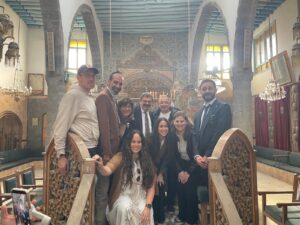
At the Al-Franje Synagogue in Damascus
The second day was filled with meetings with the President and several Deans of the University of Damascus – a university with 200,000 students. There was also a larger convening with twenty professors and students. Discussions focused on possible partnerships between the American universities and the University of Damascus.
The delegation headed to the Damascus National Museum to discuss future collaborations between NYU and the museum around the Dura Europas frescoes from a nearly 2000-year-old synagogue beautifully persevered in the museum. After another kosher dinner at the Semiramis, the participants were guests of honor at an event with the Syrian American Business Council.
On the final day of the trip, the group visited a stunning villa from the 19th century. Upon learning that the Damascus airport was closed due to fog, their dear (new) friend, Mohammad, who worked for the Syrian American Business Council, arranged a minivan to drive (with an armed escort) all the way to the Amman airport in Jordan where everyone caught flights back to the US.
This was Rabbi Lopatin’s third visit to Damascus in the past year. “We were deeply inspired by the kindness, warmth, and sincerity of the Syrian people—among the most generous and welcoming individuals I have encountered in my travels,” he said. “From government officials to business leaders and their families, from young people to elders in Damascus, and even our guards, who eagerly took photos with us and were constantly attentive to our safety, we felt nothing but hospitality and care.” Rabbi Lopatin reported that they felt safe throughout the visit. He is hopeful that a “new Syria can build lasting relationships with the United States and the broader Western democratic world, and that it may one day become a genuine partner of Israel’s—one in which Syria benefits from all that Israel has to offer, and Israel benefits from an Arab neighbor committed to peace with all its neighbors.”