
Mike Shriberg, Director of University of Michigan Water Center
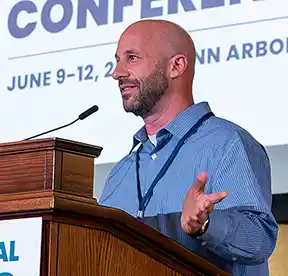 As a steering committee member of the Ann Arbor Jewish Climate Circle and an environmental professional, I believe that we in the Jewish community have a responsibility to be good stewards of our planet. And I’m proud of the leadership that our community has shown to date – Data centers are the next level of challenge that I hope we can collectively show leadership on. My particular focus is on water.
When I have given public talks as Director of the University of Michigan Water Center over the past year, I can all but guarantee that the first question will be about data centers. The issue has risen so fast in the public conscientiousness because proposals for new, large data centers seems to be springing up everywhere, raising critical questions for the communities they are targeting.
From the perspective of water, which is only one of many important factors, the first key thing to understand is that there is wide variability in water usage. Some data centers use immense amounts of water through evaporative cooling, consuming up to 5 million gallons per day (as much as a city of 50,000 people). Others use technology more like your home air conditioning system, consuming more like 100,000 gallons per day. Yet others use fluids other than water for cooling, thus reducing water usage to more like a typical commercial building.
With these differences, it would seem like there’s an easy choice for communities facing data center proposals: Require the most water efficient technology to ensure that resources are not depleted. Unfortunately, it’s not that easy. The more water efficient technologies onsite at data centers typically lead to higher energy usage, which causes much higher water usage offsite to generate that electricity, assuming that energy comes from fossil fuels or nuclear, as most of our electricity in Michigan does. The best solution? Combine water efficient technologies with renewable energy to power those technologies, requiring the companies operating the data centers to pay for the energy acquisition and grid upgrades. That can be a win for a local community – but it requires transparency and good faith efforts from the company proposing the data center and strong local government enforcement of zoning ordinances, which is the primary leverage point.
Beyond water impacts, the other question that I nearly always get when discussing data centers is how we can reduce demand for them. Again, the answer isn’t easy because the demand is being driven largely by increased AI, and AI is becoming embedded in many things that we have little or no control over. However, we do have the ability to limit our own AI usage. While there are too many variables to reliably equate specific water usage to a specific AI search, the simple rule of thumb is to only use AI when truly needed and to turn off the automatic AI search functions in browsers. At the individual level, in addition to advocacy for reduced impacts from data centers, that’s the best way to limit water usage. Overall, as Jews, I hope we can lead in both individual responsibility and as a collective force for positive policy and practices during this time of immense transition and change as AI takes off and data center proposals to power AI keep emerging.