
By Limor Regev, Nahalal and Amichay Findling, The Jewish Federation of Greater Ann Arbor
The Jewish Federation of Greater Ann Arbor holds a special connection with the Israeli community of Moshav Nahalal, as part of the global “Partnership 2Gether” project of the Jewish Agency for Israel. As part of the partnership between the two regions, community members from Ann Arbor and Nahalal meet occasionally online for Zoom conversations and presentations about various topics.
The latest meeting of the two communities included a presentation by Limor Regev, former Chair of Moshav Nahalal’s Local Committee. Limor shared with attendees the ways that Moshav Nahalal deals with current and potential future emergencies, with the local community’s resilience, and the ways in which support from their friends in Ann Arbor has made a difference recently. In addition, Limor, a native of the western Negev, is deeply connected to communities who were among the most severely affected by Hamas’ Oct. 7th massacre.
Limor shared her thoughts and emotions about their situation:
Israel is in a situation like never before. The settlements of the Western Negev are evacuated, only the readiness team and farmers are left in the deserted settlements. Women, children, and most of the population are exiled in our land. The IDF is fighting inside the Gaza Strip, and every day there are casualties, wounded, and killed. The rocket fire on the settlements continues. Not at the rate of the beginning of the war, but still disturbing and threatening.
In the north, Hezbollah is careful to walk on the edge. They are shooting anti-tank missile and rocket fire at the settlements near the fence. The IDF is retaliating, and ready for ground operations. The residents of the northern settlements near the Lebanon border are evacuated and are currently more threatened than those in the south. In several kibbutzim on the northern border, about half of the houses have been damaged so far, and the citizens dare not approach the orchards exposed to Lebanese territory. Hundreds of thousands of people from both fronts are in temporary housing, and the implications for the school year, community life, and people’s livelihoods are significant. Tens of thousands of reserve soldiers, serving for over a hundred days, are fighting on the front, maintaining preparedness, and absent from their homes and workplaces. In addition to all this, the situation in the West Bank is tense. The IDF is dealing with attacks every day.
The situation in Nahalal
On the one hand, Nahalal is currently one of the quieter and more peaceful places in Israel today, but everyone understands that everything can change in an instant.
In Nahalal and our surrounding area, there are thousands of evacuees from the north and the south, who need a lot of physical and mental support. At the peak, at the beginning of the war, Nahalal prepared living spaces for more than 80 people, and there are currently about 40.
Thanks to the Ann Arbor community’s generous donation, we equipped ourselves with rescue and life-saving equipment for the readiness team, including ceramic vests, tactical helmets, and more.
Thanks to your donation, an exciting project of therapeutic horse riding expanded from once to twice a week, after evacuees were invited to participate for free. The full staff has volunteered their time to make this possible. This week, for example, we witnessed a particularly moving moment. A sensitive horse was treating an evacuee who was in a particularly difficult and distressed situation, when it literally lay down on the ground out of empathy. This act is a known phenomenon, but very rare, and it shows the strong connection between the horses and the people.
The community here supports and helps the spouses of the reserve soldiers in cooking, helping with the children, and various things as needed. Due to the situation, we have established a volunteer support group in Nahalal. The wives of reservists and mothers of soldiers meet every week on Tuesday or Wednesday, along with a team of social workers and a clinical psychologist. Every week, the women (and of course men are also invited) express their concerns and share how they are coping during this difficult time at home.
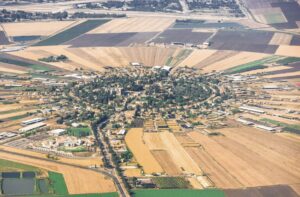
Nahalal’s circular layout
Some of the reservist soldiers have started to return to the circle [a name for Nahalal referring to the community’s circular layout]. We are also trying to provide a response for them, both emotional support and support for their spouses until they adjust. For the reservist soldiers, we opened a local pub so that there would be a place to meet and feel a part of the community again.
In parallel, there is a general preparedness assessment for extreme war situations from the north. Last week, a comprehensive exercise was conducted involving all forces, in which over a hundred people from Nahalal participated: the emergency teams, the preparedness and care teams, teams for evacuating rubble and rescuing people from homes, teams for emergency electricity and water infrastructure, firefighting teams, medical teams, and teams for taking care of animals in case of damage to chicken coops, cowsheds, or other infrastructure.
Thanks to many donations and internal mobilization, Nahalal filled its equipment and other deficiencies in rescue and medical equipment and is improving its preparedness. And for that, I want to say thank you again. This mobilization on our behalf is not taken for granted. We all understand that if a total war breaks out on the northern front, the fact that Nahalal is so close to the Ramat David Air Force Base will make Nahalal a central target for Hezbollah’s fire. Since there are many large settlements in the area, including Afula, Migdal HaEmek, etc., the chance that emergency teams will be available to reach Nahalal and treat us, in quick time frames, is very low, and we must be prepared to handle all aspects of the emergency ourselves.
My connection to the Western Negev
I want to conclude on a personal note. As some of you know, I was born in Kibbutz Magen, which is adjacent to the Gaza Strip.
Many of the victims that day, and their families, are people I knew, including my teachers from school, family members of my classmates, and also some members of the kibbutz where I grew up.
Immediately after October 7th, graduates of the local school in the Western Negev organized to establish a big tent and demand the release of the kidnapped. The stand is located on Kaplan Street in Tel Aviv.
To gain media attention and to advance the issues so important to us, we hold events, and this week we had a meeting of school graduates and teachers. Among the hundreds of participants were former teachers and principals, as well as 2 former teachers who were released from Hamas captivity and came to express support for the release of the other kidnapped.
I am a partner in this effort and I believe that there is no more important moral, ethical, and national duty than this, and no task more important than this to release the hostages, so that we can continue to live here in this land.