
Below are reflections from those who had the pleasure and honor to participate in a solidarity mission to Israel the last week of March 2024. Although it was only a 4-day trip, this group saw, met, heard, experienced, and witnessed more than most trips typically provide. Participants were hosted by families in Nahalal, Ann Arbor’s partner community through the Jewish Agency’s Partnership2Gether program—and Ann Arbor’s “family” in Israel. Those in Nahalal and the Partnership office helped coordinate numerous opportunities to volunteer, learn and experience first-hand the enduring effects of the October 7 attacks. The participants in this trip were proud to represent the Ann Arbor community and offer their individual reflections here.
Eva Solomon
When we decided at one of our “partnership” meetings that we were going to organize a solidarity mission, there was no question in my mind that I was going to go. I couldn’t articulate the exact reason, but I knew I wanted to be there. When I told people that I was going to be traveling to Israel, their reactions took me by surprise: “Why are you going there?” “What are you going to do there?” “Are you sure it’s safe?” I had to come up with an answer so I replied that I am going to stand in solidarity with my Israeli family, to volunteer, and to bear witness to the atrocities of October 7th. All they could say after that was, “Be safe.”
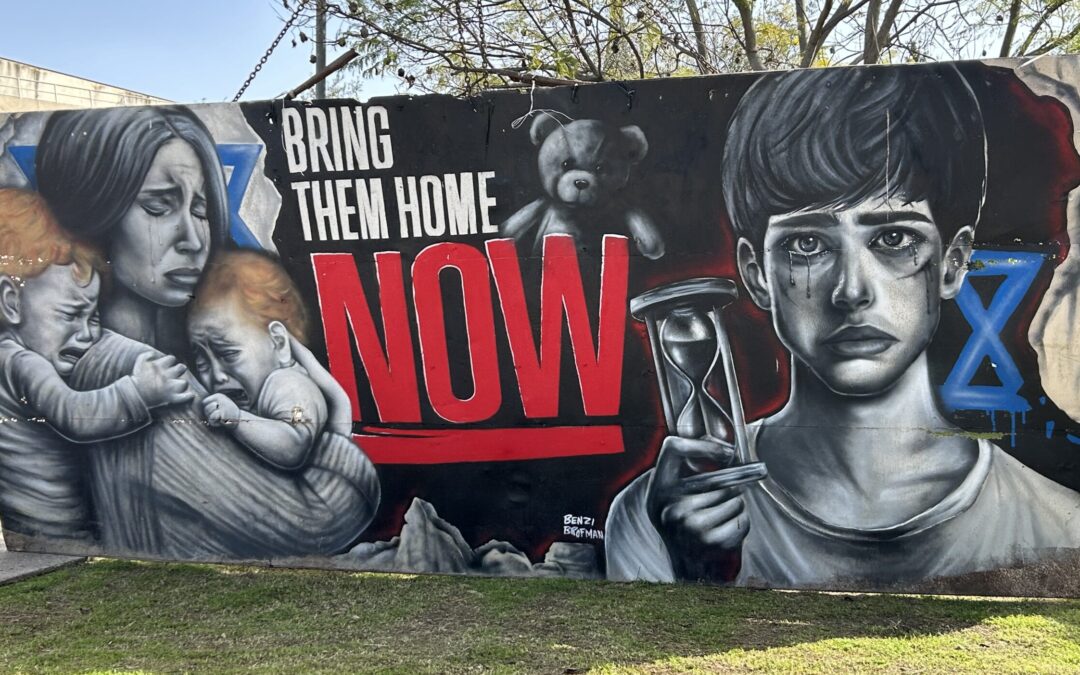
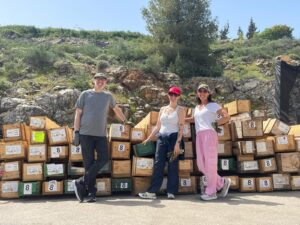 When I arrived, it was clear to me that bearing witness was the least I could do. People were grateful for us to just be there. The resilience of the Israelis never ceases to amaze me. Even as war continues in Gaza and deadly rockets are being fired against the north every day, and world sentiment seems unbalanced against every move Israel makes, the people are coming together. We felt it with every place and every person we visited, including: “Hamal,” the volunteer command center where we moved lumber to build shelter for soldiers, graffiti artist Bentzi Brofman’s art exhibit installation of portraits of hostages and murdered soldiers, Bat Ami from Kibbutz Hanita who has been living in a college dormitory with her family since the beginning of the war, Nadav HaMeiri who offers therapeutic horseback riding for evacuated families, Shaul Avidav who is head of the first response team in Nahalal, Meital Liani and others from Kibbutz Gevim community who were evacuated to Kibbutz Mizra and finally moved back home, those who survived and didn’t survived fleeing from the Nova Music Festival, relatives of hostages at Hostage Headquarters, and Boaz who used his archaeology skills to recover missing people.
The last time I was in Israel was this past May. At that time, I witnessed and participated in a government protest. On this trip, I saw frustration with not only the leadership of the government, but also its mishandling this war. Despite the failure of the government and IDF leadership to foresee the massacre, the people are determined to defeat Hamas and rescue the hostages.
There is no obvious answer to end the war. The greatest asset is the strength and resiliency of the Israeli people, but they can’t do it alone. We need to stand by their side and continue to find ways to help.
Brad Axelrod
I just returned from a 4-day whirlwind trip to Israel, a country that remains resilient in the face of the horrific terror attacks on October 7, 2023. Entering the welcome hall at Ben Gurion 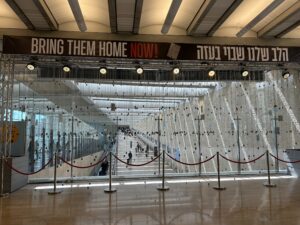 airport, one no longer sees the huge wall posters of smiling faces celebrating the land of Israel. Instead, one faces the photographs of all 134 Israeli hostages currently in captivity in Gaza. Along both sides of the hallway is a long line of each of their names, ages, and faces. The people of Israel are united in seeing their priority being the return of the presumed 100 living hostages and the remains of 34 who are thought to have died or been killed since being taken captive.
The attention devoted to those killed, injured, and still in the hands of Hamas are seen in artwork throughout Israel, conversations with displaced residents who just returned to their homes in the western Negev, discussions with family members of the hostages, grassroots organizations with whom we volunteered, a presentation by an archeologist responsible for identifying the remains of missing people, and bearing witness to the loss of life at the Nova Music Festival, along Highway 232, and throughout the western Negev area, and mental health treatment (including equine therapy) for those with posttraumatic difficulties.
Despite the unspeakable loss of life and security, Israel’s spirit is robust and her promise for the future is irrepressible. The most often heard comment during the trip was, “Thank you for being here.” My response: “I can’t wait to be back.” Am Yisrael Chai.
Levana Aronson
I went early. Entering Israel airport was already sobering, along the walk to the passport control one can see the hostages’ pictures, looking at you –Bring me home!
I have never seen the Israelis so humble and vulnerable no matter where you meet them, they sincerely thank you for coming.
On the one hand, when one is in the center of Israel/Tel Aviv area and Haifa, life is “normal”. People are working, going to the theater and movies, sitting in cafes, going to restaurants, as if no war is happening. But the mood is subdued. Everything is “if,” “when.”
I went to the theater. As the show began, the announcement was, “You are sitting in a sheltered area. In case of a siren, please don’t leave your seat. The actors will leave and come back after clearance.” Can you fathom going to the Power Center or Hill Auditorium under these circumstances? This is “normal.” The audience was primarily middle-aged seniors, and women.
One Saturday, I went to the beach. People were walking, playing “matkot” and sitting in the cafes. Again, women and children and older people. This is “normal.” They say, We are doing it because this is what our children, spouses, significant others are fighting for… so we can have “Normal Life.”
Saturday night comes and the debate is, which demonstration shall we go to? For the hostages? For the protest of the government? Or maybe neither because our children and spouses are fighting.
Israel needs us, Israelis need us. They are fighting for their survival and they know it!
Taryn Gal
October 7, 2023 was horrific, obviously. But, it was the response to October 7th from friends, colleagues, and previously respected organizations that was a gut punch to my core. Given that I am someone who has fiercely fought for diversity, equity, inclusion, anti-oppression, and social justice, it was absolutely surreal to experience the immediate and unquestioning mis-use of these ideals against Jews; against me. Everything I thought to be true was false. In the days following October 7th, my understanding of the world turned upside down. In all my time fighting for others who hold historically marginalized identities, I had let my own historically marginalized Jewish identity be put aside. Jew-hate was left to simmer right beneath the surface (just as my grandparents had always told me was there, but I had ignored). Now, many whom I had loved and trusted, felt free to unabashedly declare their Jew hatred in a multitude of both loud and quiet ways.
After October 7th, I felt a strong and overwhelming need to get to Israel, to go, and to be there. And I felt an overwhelming need to get away from Ann Arbor and the daily gaslighting and microaggressions from those around me. I had never been to Israel, nor had I ever had much of a desire to go there. I don’t like traveling in general. Yet, now I did, even somewhat shocking myself with this yearning to get there. I needed to see, to feel, to be present in the spaces that were impacted by October 7th. I needed to be with my people.
I am not religious. I am more of an atheist. Yet, it felt that G-d had a hand in connecting me with the Jewish Federation of Greater Ann Arbor and their partnership with Nahalal. The Solidarity Mission brought out every emotion (anger, rage, sadness, hope, despair, love, hate, pride, fear, more rage, and even more love) and was exactly what I needed to fill the hole that was left in me by those who let me down, so severely, over the past six months. We were able to bear witness at sites attacked by Hamas. We visited art exhibitions created in response to October 7th. We listened to journalists, survivors, displaced families, relatives of hostages, community response teams, a social media influencer, members of the IDF, and representatives from Hostage Headquarters. We heard bombs dropping and saw Gaza. We volunteered with an organization that jumped in to help IDF soldiers when the government would not. We stayed with families. It felt like home. The thread throughout every interaction was love and life; return of the hostages and protecting the soldiers.
A few experiences that caught me off guard:
Over the past six months, I have watched video clips from the Nova festival. The only sound was the crunching of dry grass as they ran through the open fields away from Hamas. As I now walked through the same fields at Nova, I heard the same sound, on the same grass. A sickening closeness; incredibly important and necessary to me.
At Hostage Square, I found myself looking for the protestors. Looking for the individuals who would vandalize the sculptures and displays in the plaza. There were none and there would be none. This was Israel, not the US.
Permanent bomb shelters. Everywhere. This is a country that has chosen to acclimate to constant missile attacks, rather than fight back against hateful neighbors. It has chosen life over death, time and time and time again.
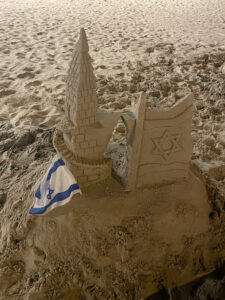 On my last night in Israel, I was alone in Tel Aviv. I walked along the beach. For all the hateful “river to the sea” comments that I see on my social media feeds, I was able to actually see “the sea.” After months of heartbreak seeing “from the river to the sea” posted online by friends and colleagues, it felt that I was almost able to reclaim “the sea,” whose beach was filled with Jewish life and Jewish love.
What do I now do with this now that I am back in Michigan? One volunteer group asked us to raise money for an ice cream truck for the soldiers. Another community said they need funds for equipment to convert pistols into assault rifles. The journalist we met had the most difficult request – he told me that it is the job of American Jews to start combating the inaccurate and harmful propaganda spreading Jew-hate. We must be louder, we must put ourselves on the line to fight this fight here in the US.
My flight back to the US was so wild that it made the international news: wind shear, landing at a different airport, emergency medical responders on the plane. I happened to share a Lyft with someone from the flight as we navigated hotels and rescheduled flights. As she got out at her terminal, she said, “Next year in Jerusalem.” Yes, next year in Jerusalem. Am Yisrael Chai.
Carey Sherman
Since October 7, I haven’t been able to turn my gaze away from what was happening in Israel. When a solidarity mission was discussed, I knew I had to be part of it.
During the brief yet profound time in Israel, we were privileged to hear raw, first-hand accounts from individuals directly impacted by the deadly attacks perpetrated on Israelis in the Gaza Envelope. An older father, who made Aliyah to Israel from Argentina, now works tirelessly to hasten the release of his two adult sons still held captive by Hamas. A young research archaeologist now focuses on painstaking forensic archeological to map the site and reclaim any extant remains of civilian and military victims of Hamas’ missile attacks and fire. One woman, mother of 6 children, described how she and others had only hours to evacuate their community, Kibbutz Givim, to escape surrounding terrorists. They have only just returned to their homes after a five-month displacement. Countless individuals across Israel continue to dedicate their talent, time, and compassion to support affected communities, provide needed supplies to those fighting, and provide any form of comfort to the family members of victims viciously murdered or taken hostage by Hamas.
A particularly sobering visit was to the site of the Nova Music festival, near Kibbutz Re-im. 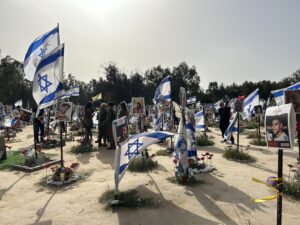 As we each walked quietly through that landscape where over 360 innocents—mostly young—were brutally murdered, I kept thinking of the line from Psalm 23, “ גַּם כִּי-אֵלֵךְ בְּגֵיא צַלְמָוֶת — Yea, though I walk through the valley of the shadow of death…”
We were there, “in the valley,” on ground soaked with blood and haunted by the “shadow of death.” Now, sapling trees have been planted for each victim along photos of the victims’ beautiful, vibrant faces. Bearing witness to the worst massacre in Israel’s history, we can never fully grasp the totality of what was lost on that day. The legacy of abject violence etched in that soil will reverberate forever.
As the verse continues, “ לֹא-אִירָא רָע, כִּי-אַתָּה עִמָּדִי — I will fear no evil, for Thou art with me.” The Psalmist is referring to God, but I find an added layer of meaning in these words. We have seen evil, and we do fear evil. And yet, at each stop during our visit, and in our hosts’ homes in Nahalal, we heard testimony from Israelis stepping up in stunning ways to honor, serve, assist, and comfort those in need. Remarkable collectives of volunteers are dedicating themselves around the clock to creating a stronger, better, more unified Israeli society going forward. In their unity and work, there is hope for the future.
Now, with these images in my head and heart, I keep asking myself how will we, as individuals and as a community, step up to show our solidarity, love and support to the land and people of Israel during this most challenging time? How can we best combat the new global “Holocaust denial” about what happened on October 7th to Israel and the Jewish world? Meeting this moment is an existential imperative, and I sincerely hope we can find the same strength and unity of purpose in our efforts as our Israeli sisters and brothers. Am Yisrael Chai.