
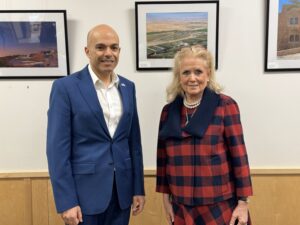
Yinam Cohen (Israel’s Consul General to the Midwest) and MI Congresswoman Debbie Dingell at breakfast at the JCC.
The Jewish Federation of Greater Ann Arbor was honored to host the Consul General of Israel to the Midwest, Yinam Cohen, for a community breakfast on February 21. About 25 people, including Michigan State Representative Jennifer Conlin and Congresswoman Debbie Dingell, heard remarks from and engaged in conversation with Mr. Cohen.
The breakfast coincided with a new report from the Association of Rape Crisis Centers in Israel. This report provided further evidence of the systematic and brutal sexual violence perpetrated by Hamas on October 7. During his presentation, Consul General Cohen thanked Congresswoman Dingell for raising this issue at the highest levels.
In addition, Mr. Cohen outlined the goals of Israeli leadership for the war in Gaza:
- To eradicate the Hamas infrastructure. Hamas leaders have publicly indicated their plans to perpetrate more attacks like October 7 – Israel must make sure that will never happen.
- To create conditions to release the rest of the hostages. There are still over 130 hostages, some of them already dead, being held in Gaza. Six of them are American citizens. Mr. Cohen said that the initial hostage release in November would not have happened without Israel’s military pressure.
Mr. Cohen explained that there are ongoing negotiations with Egypt, Qatar, the CIE, Mossad, Shin Bet and others to release the remainder of the hostages, and it appears there is an aim to complete these negotiations by the start of Ramadan, which begins March 10. Mr. Cohen is hopeful that there will be an extended cease fire, a release of hostages, and humanitarian aid provided to Gazan citizens. He also pointed out there are about 200,000 internal refugees in Israel who have been displaced from their homes in the south and in the north. Much work is needed to address their housing, education and nutritional needs.
The consul general praised President Biden for his genuine support and moral leadership. He also mentioned that in September, Israel celebrated three years since the Abraham Accords. Unlike the cold peace between Israel and neighboring Egypt and Jordan, the Abraham Accords peace treaty has been embraced by the people of Israel and the UAE – not just governmental institutions. There is regular travel between the two countries, and Israelis of Moroccan descent are traveling to Morocco to connect with their roots. There have also been unprecedented tri-lateral military exercises with the US, Bahrain and Israel. Additionally, Israel and Saudi Arabia were very close to a peace deal when Hamas attacked on October 7. Hamas’ timing was designed to interrupt this process and is certainly at the direction of Iran, which materially supports Hamas, Hezbollah, Islamic Jihad and the Houthis in Yemen.
In response to questions about how to talk about Israel and Gaza in the face of extreme anti-Israel rhetoric, Consul General Cohen provided some key talking points.
- Hamas is a US Designated terror organization. It is a radical Islamic group with a charter calling for the eradication of the Jewish State.
- There has not been an occupation of Gaza since 2005.
- In 2005, Israel left Gaza completely and hoped there would be peace.
- In 2007, Hamas was voted into power and has been in control ever since.
- Hamas chose to use its resources on missiles and tunnels, not on food, education, electricity, etc. Rather than building a thriving state on the sea, they utilized the funding and materials provided by US tax dollars and humanitarian and economic aid from countries around the world to build over 400 miles of underground tunnels for military purposes. This is more mileage than the NYC subway system.
- In 2023, a record number of Gazans were given permits to work in Israel (about 23,000). We know now that many were using the opportunity to collect intelligence for the attack. Hamas documents have detailed information from Gazans working in Israel about every community attacked.
- Gaza is not an “open-air prison”. It is a separate territory, and borders are in place, just as they are between countries around the world.
- Israel provides electricity and water and then is criticized for controlling these resources.
- The Erez crossing, where much aid and water enters Gaza, was attacked on October 7 – Hamas blew up H2O pipes which Israel has repaired.
- Although not obliged to do so, Israel is still supplying electricity and water.
- Gaza also has a border with Egypt. That neighbor has built a six meter wall topped with barbed wire to keep Gazans out. Israel’s border with Gaza was a fence.
- While the civilian death toll is very concerning, Newsweek reported that the Israeli military has done more than any other nation in history to prevent civilian deaths.
- When the press report numbers from other conflicts, they indicate when the numbers are not verifiable. When they report numbers provided by Hamas, they take them at face value and do not indicate they are not verified.
- Hamas often inflates the numbers they provide. When it was reported that an Israeli missile hit a hospital, they reported that almost 500 people were killed. When it became clear that the hospital was damaged by an errant Islamic Jihad missile, they decreased the number of 100.
- 25% of missiles aimed at Israel misfire over Gaza killing Palestinian civilians.
- There is ample evidence that Hamas uses civilians as shields, operating out of their homes.
- In other conflicts, the ratio of military to civilian deaths is much higher than in Gaza. When Americans were in Afghanistan and Iraq, the rate was 1 military death to every 4 civilian deaths. Even using Hamas’ numbers, about 1/3 of the fatalities are Hamas terrorists – the ration is 1 to 1.7/1.8.